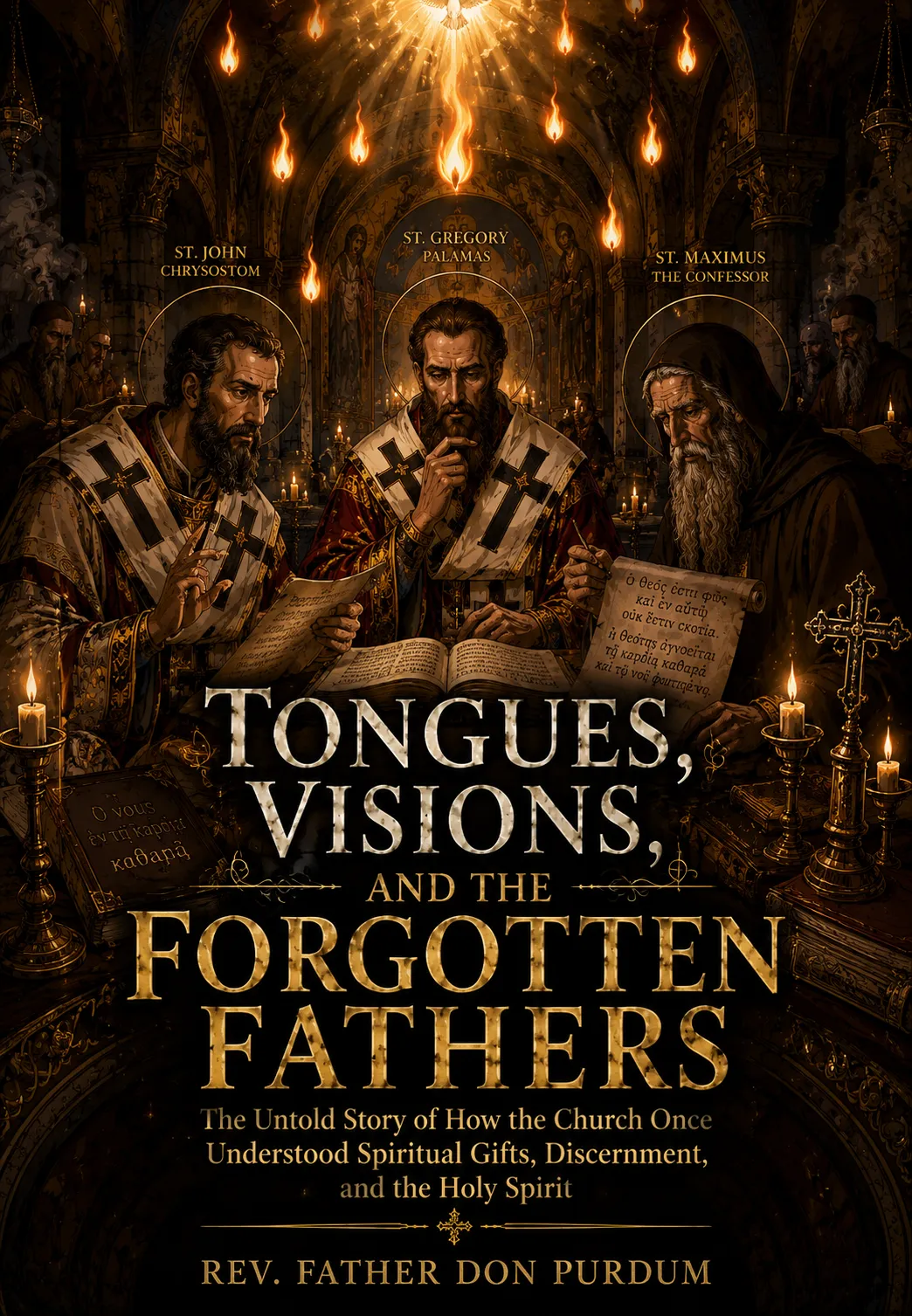
Tongues, Visions, and the Forgotten Fathers
The Untold Story of How the Ancient Church Once Understood Spiritual Gifts, Discernment, and the Holy Spirit
There's a question that's been quietly nagging at millions of Christians.
Not the skeptics. Not the cynics. Not the people who walked away from faith entirely.
The ones who are still showing up. Still hungry. Still searching for something deeper than what Sunday morning delivers.
Here's the question:
What did the ancient Church actually believe about the Holy Spirit — and how is it different from what most of us were taught?
Because here's what's interesting.
For the first thousand years of Christian history, the Church had a remarkably consistent understanding of spiritual gifts, divine encounter, and what authentic experience of God actually looks like. The desert Fathers mapped it. The great theologians articulated it. The saints lived it.
And most modern Christians have never heard a word of it.
Not because it was hidden. Not because it's irrelevant.
"I read this book in one sitting on a plane journey. It was life-changing for me."
Karen W.
Because somewhere along the way, a different framework replaced it — and that replacement happened so gradually that almost nobody noticed what was lost.
My father, Rev. Father Don Purdum, spent years tracing exactly what happened. What he found surprised even him.
The ancient Orthodox tradition offers an understanding of the Holy Spirit that is simultaneously richer, more demanding, and more magnificent than anything most of us encountered growing up — regardless of which tradition shaped us.
And it raises questions that every serious Christian deserves to sit with.
Here's What I've Noticed
I've spent years wrestling with this exact question.
Not from a place of cynicism. Not from a place of armchair theology. From a place of genuine pastoral care for people who are hungry for the real thing and keep getting handed counterfeits.
He went back to the source.
Not the 1906 Azusa Street Revival.
Not the 1835 Charles Finney playbook.
Not the 1994 Toronto Blessing.
I went back two thousand years.
To the desert Fathers.
To St. Basil the Great.
To St. John Chrysostom.
To St. Gregory Palamas.
To the men and women who actually walked the path of authentic encounter with God and left detailed maps of the terrain.
What I found is sobering.
What "Tongues, Visions, and the Forgotten Fathers" Actually Is
This isn't an attack on Charismatic believers. Let me be straight about that.
This is a historically rigorous, theologically grounded examination of a question that 600 million Christians need to be asking: Does the framework I've been given for understanding spiritual gifts, divine presence, prophecy, tongues, and spiritual experience actually match what the Church has taught for two millennia?
Or did something get lost along the way?
Here's what the book lays out.
The ancient Church understood the Holy Spirit as the life of the Church — communal, sacramental, and inseparable from the apostolic body of Christ.
Modern charismaticism, shaped by centuries of post-Reformation individualism, treats the Holy Spirit primarily as the author of personal emotional experiences.
That's not a minor difference.
That's a completely different operating system.
The Fathers taught that spiritual gifts say nothing about the holiness of the person who has them.
Chrysostom was explicit — people who prophesied and cast out demons in their own power fell into apostasy. The gift was God's, not theirs. Modern charismatic culture treats the possession of spectacular gifts as proof of spiritual authority. The results have been predictable and catastrophic.
The three-stage path of purification, illumination, and union that runs through the entire ancient tradition, from the earliest desert Fathers to the Byzantine hesychasts, makes a claim that directly contradicts the charismatic playbook: you cannot shortcut your way to genuine encounter with God.
A soul that hasn't been substantially purified will misinterpret, misuse, and ultimately be damaged by the very gifts it receives.
The historical trajectory from the Reformation to Pentecostalism is not a story of "restoration." It's a story of progressive dismantling — of the sacramental, ecclesial, and ascetical frameworks that had served as safeguards against spiritual deception for fifteen centuries.
Each generation went further than the last.
Finney engineered revival as a human achievement.
Azusa Street added tongues as mandatory evidence.
The Toronto Blessing introduced manifestations that have no precedent in any recognized Christian tradition.
And Bethel Church has taken it to places that would have alarmed even the early Pentecostals.
Every step of that trajectory moved in the same direction: from the objective to the subjective, from the communal to the individual, from the sacramental to the experiential. And at every step, the ancient safeguards got stripped away.
But This Book Isn't Just Critique
And this is the part most people miss.
The ancient Christian tradition doesn't just say "that's wrong."
It says "here's what's actually available."
Theosis.
Deification.
The genuine participation of the human person in the divine life.
Not a spiritual experience.
Not a moment of emotional intensity.
The actual, permanent transformation of the whole human person — body, soul, and spirit — into the likeness of Christ.
That's infinitely more ambitious than anything the charismatic movement has ever imagined.
St. Seraphim of Sarov radiating divine light in a Russian forest, visible to his disciple who was overwhelmed by warmth and fragrance in the middle of winter.
That's not emotional stimulation.
That's not crowd psychology.
That's a human being so thoroughly indwelt by the Holy Spirit that his physical body began to manifest the divine luminosity that is humanity's ultimate destiny.
The ancient path to that reality runs through repentance, humility, watchfulness, sacramental participation, and the slow unglamorous work of purifying the heart.
It's not exciting.
It doesn't fill stadiums.
It doesn't generate viral content.
It produces saints.
And the witness of those saints — their holiness, their love, their genuine and unmistakable participation in the divine life — is the most compelling evidence that can be offered for the ancient path's validity. Not the spectacular manifestations that the charismatic movement prizes.
The quiet, deep, permanent transformation of human persons into something that looks like Christ.
Who This Book Is For
If you've spent years in charismatic or Pentecostal churches and something has always felt slightly off...
If the emotional highs keep requiring more intensity to sustain...
If the prophetic words keep not coming true...
If the theology of healing has left you carrying guilt on top of illnes...
This book will give you language for what you've been sensing.
If you're Orthodox and want to understand precisely what the Fathers teach about spiritual gifts and discernment, not the watered-down version but the real thing, with specific patristic citations and rigorous theological framework — this is the resource you've been looking for.
If you're a pastor or leader watching people in your community get drawn into charismatic practices and you need a historically grounded, pastorally sensitive response that doesn't dismiss the genuine hunger but redirects it to safer ground... I wrote this for you.
And if you're genuinely hungry for God... Not for experiences, not for emotions, not for spiritual status, but for God himself... This book will show you the ancient and proven path that thousands of saints have walked before you. Not the easy path. The real one.
What's Inside
The book walks through four major sections.
Part One lays out how the ancient Church actually understood the Holy Spirit — as the life of the Church, inseparable from the sacraments, the apostolic community, and the three-stage path of purification, illumination, and union. It introduces the concept of the nous, the spiritual eye of the soul, the forgotten organ of perception that both rationalist Christianity and emotional Christianity have abandoned.
Part Two traces the historical trajectory from the Reformation through Pietism, the Great Awakenings, and Charles Finney's revival methods to Azusa Street, the charismatic explosion, the prosperity gospel, the Toronto Blessing, and Bethel Church. Not as polemic, but as honest historical examination. How did we get here? What was lost at each stage? And what does the pattern reveal?
Part Three applies the ancient criteria of discernment to modern charismatic practices such as tongues, prophecy, healing, spiritual warfare, and the culture of spectacle spirituality. It introduces the concept of prelest in detail and shows, with patristic precision, why the conditions the charismatic movement creates are precisely the conditions the Fathers warned against.
Part Four presents the positive Orthodox alternative — theosis, the Eucharistic life, hesychasm, the practice of discernment according to the saints, and the ancient understanding of what authentic encounter with the Holy Spirit actually looks like.
Not a museum piece.
A living, breathing path that is available right now.
The appendices include a timeline of Pentecostal and Charismatic history, a comparison between Orthodox and Pentecostal theology, summaries of major Church Fathers on spiritual gifts and discernment, an explanation of the nous, recommended reading, and a section examining common charismatic claims against historical and theological evidence.